Traditional hotel structured cabling typically includes three networks: fixed telephone network, cable TV network, and broadband Internet network:
- Large-scale cabling works with complex construction; the cost of structured cabling is higher than that of fiber optic cabling.
- Numerous structured cabling access points, combined with copper wire oxidation leading to poor contact, result in frequent faults that are difficult to locate, requiring considerable time and manpower for troubleshooting.
- Limited transmission distance of network cables restricts usage for users far from terminals.
- Restricted bandwidth capacity and inconvenient service upgrades tend to cause losses in upfront investment.
Adopting an all-fiber cabling solution to achieve "multi-service convergence and one-cable multi-function" aligns with the development needs of modern hotels.
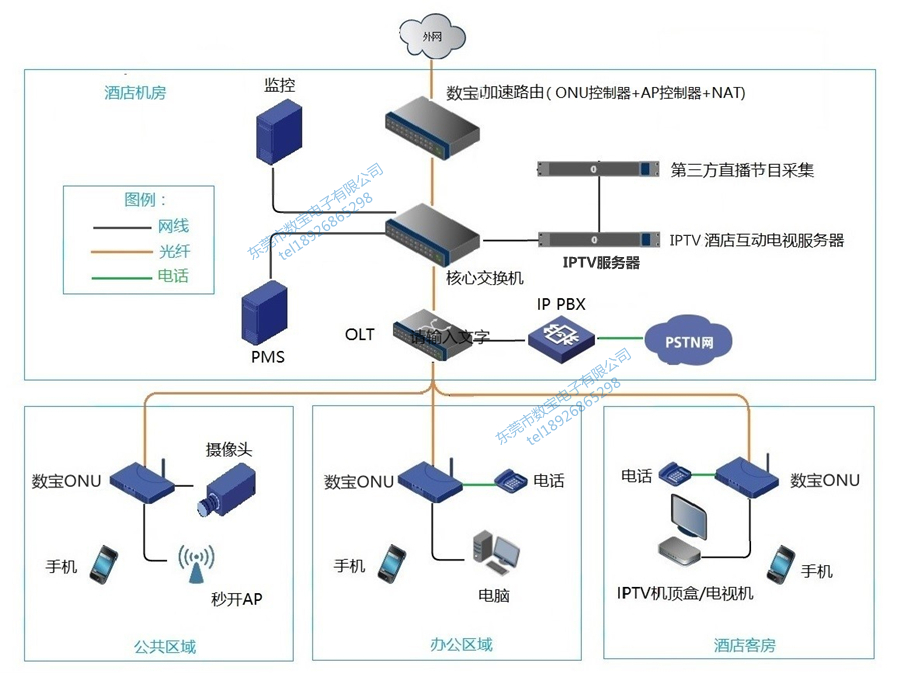
Solution Description:
Fiber optic connections are used throughout from the equipment room to guest rooms and all information access points. EPON or GPON OLT (Model: DIG-128) is deployed at the equipment room, and plug-and-play optical network units (Model: DIGONU-Z4) are used at terminals.
- Broadband Internet Access: External network connection and internal network management are handled by a Shubao router (Model: DIGR-500).
- Telephone Service: Guest room telephones connect to the ONU and then access the IP PBX via FTTH.
- IPTV: Guest room IPTV set-top boxes or customized smart TVs connect to the ONU and then access the hotel interactive TV server via FTTH (providing live TV and video-on-demand services).
- Guest Room WIFI: WIFI access is provided via the built-in WIFI function of the ONU.
- Public Area WIFI: Wireless APs connect to the ONU (the built-in WIFI of the ONU can be directly used in small areas).
- Video Surveillance: Cameras connect to the ONU.