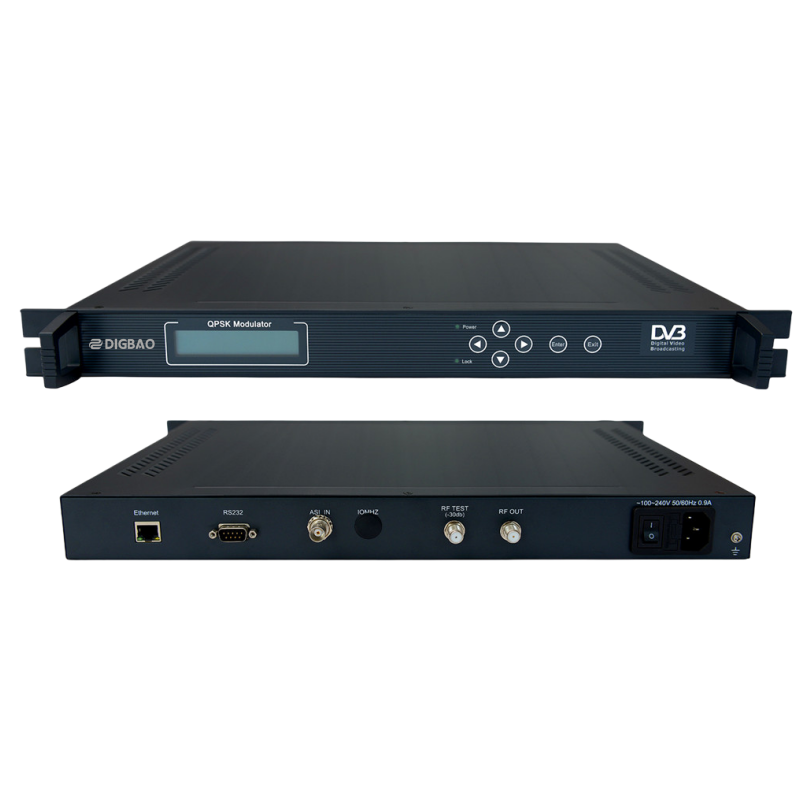
QPSK Modulator (DVB-S Digital Modulator)
Frequency Range 950–2150MHz
1 Safety Instructions
● Please read the user manual carefully before powering on the DVB-S modulator.
● Do not open the enclosure by yourself, as this will void the warranty. Internal components carry hazardous voltages, posing a risk of electric shock.
● Unplug the power cord when the modulator is not in use for a long period. Do not use damaged power sockets to prevent fire or electric shock.
● Do not touch power sockets with wet hands to avoid electric shock.
● Pull the plug instead of the cable when disconnecting power or signal cords.
● Keep flammable materials, metal objects and liquids away from the unit, as they may cause damage or hazards.
● Install the device with proper lightning protection to prevent damage from lightning strikes or power grid surges.
● Do not install the modulator near heat sources, direct sunlight, excessive dust or mechanical vibration.
● Ensure adequate ventilation during operation to prevent overheating and equipment failure.
● Retain the original carton and packaging for safe transportation. Repack using factory packaging for optimal protection.
2 Product Overview
2.1 Functions & Applications
The DVB-S modulator is a core component in digital cable TV headends. It receives DVB transport streams from encoders, multiplexers, DVB gateways, scramblers and video servers, performs RS encoding, convolutional interleaving and DVB-S modulation, and provides RF output.
2.2 Dimensions (1U Chassis)
Height: 44mm
Width: 410mm
Depth: 280mm
Weight: approx. 4.5Kg
3 Key Features
l 8M large buffer for burst stream resistance and PCR correction
l Automatic stream padding and intelligent null packet deletion
l Real-time input and output signal monitoring
l Chinese/English LCD, front-panel keypad and remote NMS control
l High-reliability design for stable operation
4 Technical Specifications
Input | ASI | DVB compliant, BNC interface |
Output | Modulation | QPSK/DVB-S (Satellite Signal) |
RF Frequency | 950–2150 MHz |
Symbol Rate | 1–45 Mbaud/s |
FEC Coding | RS Coding 188/204 |
Input Data Rate | 1.0–108 Mbps |
Channel Data Rate | 1–56 Mbps |
MER | >38 dB |
BER | 0 |
Attenuation Range | 0–20dB (0.5dB step) |
Impedance | 75Ω |
NMS | Ethernet | 10/100M RJ45 |
General | Dimensions | 482mm × 280mm × 44mm |
Environment | 0–45℃ (operating); -20–80℃ (storage) |
Power | 100–240VAC, 50Hz, 25W |
4.1 ASI Interface
Input: 2×DVB ASI ports
Connector: BNC
Impedance: 75Ω
Standard: ISO 13818-1
Max bit rate per port: 214Mbps
TS packet format: 188/204 bytes (auto-detect)
TS input mode: continuous / packet burst / irregular
4.2 RF Interface
4.2.1 RF Output
Connector: Metric F-type
Impedance: 75Ω
Output frequency: 950MHz – 2150MHz (model-dependent)
Output level: 90–110 dBuV (adjustable)
Out-of-band SNR: ≥50dB
4.2.2 RF Test Output
Connector: BNC
Impedance: 75Ω
Output level: 73–93 dBuV (adjustable)
4.3 Channel Coding
Modulation: DVB-S
Channel coding: DVB-compliant RS coding
MER: ≥36dB
Out-of-band SNR: ≥50dB
4.4 NMS Interface
Ethernet: IEEE 802.3, RJ45
Protocol: UDP/IP
4.5 EMC & Safety
Compliant with GB13837-92 and GB8898-88 standards.